

How to make a symbolic ceremony more engaging?

Our wedding planner tips for a meaningful and engaging ceremony
A symbolic ceremony is often one of the most powerful moments of a wedding. More personal than a civil ceremony and more flexible than a religious one, it allows couples to tell their story and celebrate their union surrounded by their loved ones.
However, because it is entirely customizable, one question often comes up: how can you avoid a ceremony that feels too long or monotonous?
Here are our wedding planner tips to create a symbolic ceremony that is dynamic, emotional, and truly memorable.
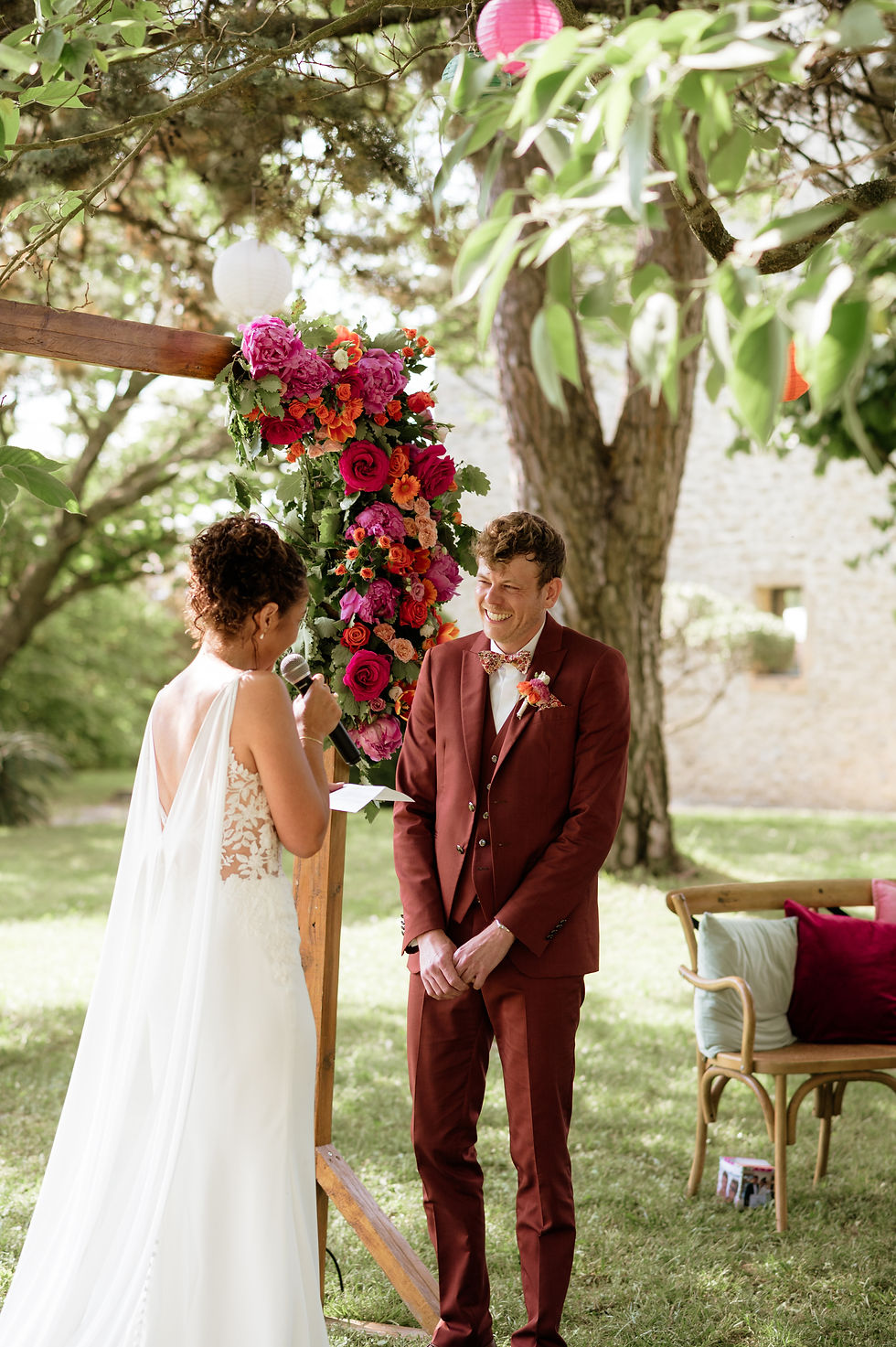
What is a symbolic ceremony?
A symbolic ceremony is a non-religious and non-legal celebration of a couple’s union.
Unlike a civil ceremony, it has no legal value, but it is often the most emotional part of the wedding day.
It allows you to:
tell your love story
involve your loved ones
share readings, speeches, or music
include symbolic rituals
exchange your vows and rings
The ceremony is usually led by an officiant, either a loved one or a professional.
And most importantly: there are no strict rules.
Finding the right rhythm
The key to a successful ceremony is rhythm. An ideal ceremony usually lasts around 45 minutes, and at most 1 hour. Beyond that, guests’ attention may start to fade.
To maintain energy, it’s important to alternate different moments:
speeches from loved ones
symbolic moments
music
rituals
emotional or light-hearted moments
This balance helps create a ceremony that feels both moving and engaging.
Creating a memorable entrance
The entrance of the couple is a highly anticipated moment.
To build emotion and anticipation, it’s important to stage it carefully.
For example:
have the procession enter first (witnesses, parents, children…)
then announce the arrival of the bride or the couple
accompany the moment with a meaningful piece of music
A simple sentence can be enough: “Ladies and gentlemen, please welcome the couple.”
Involving your loved ones
Speeches from friends and family bring a deeply personal dimension to the ceremony.
They can take many forms:
readings
personal anecdotes
childhood memories
songs
heartfelt testimonials
To keep the ceremony dynamic, we recommend:
limiting each speech to 3/4 minutes
varying the speakers
alternating between emotional and lighter moments
Including a symbolic ritual
Rituals create a visual and participative moment within the ceremony. Here are a few examples:
The candle ceremony: The couple and their loved ones light candles representing the past, present, and future.
The sand ceremony: Each partner pours a different colored sand into a single vessel, symbolizing their union.
The ribbon ceremony: Loved ones tie ribbons around the couple’s joined hands to seal their union.
These moments create a pause in the ceremony and help capture the guests’ attention.
The exchange of vows: the key moment
This is often the most anticipated part of the ceremony. Couples can write their own vows or choose a more traditional format. What matters most is that they feel authentic and personal.
This is where emotions are at their highest.
Don’t forget transitions
A good officiant keeps the ceremony flowing with simple transitions.
For example:
introducing speakers
announcing rituals
refocusing guests’ attention
These small elements help avoid awkward pauses and maintain a smooth rhythm.
Ending on a strong moment
The ceremony usually concludes with:
the exchange of rings
the officiant’s closing words
the couple’s kiss
This is the perfect moment to start the music and invite guests to celebrate the couple.
A wedding planner’s tip
A successful symbolic ceremony is built on three elements: emotion, rhythm, and personality.
Most importantly, it should reflect who you are as a couple.
That is what makes it truly unique.
If you are currently planning your wedding and thinking about your symbolic ceremony, feel free to get in touch. We would be delighted to help you design a ceremony that truly reflects your story.


Comments